Deep within the fossil records and isolated ecosystems of islands lies a curious pattern—a recurring evolutionary trend where large mainland animals shrink in size over generations when confined to island habitats. This phenomenon, known as island dwarfing, has produced some of the most bizarre and fascinating creatures in Earth’s history, from dwarf elephants to miniature hippos. The process isn’t just a quirk of nature; it’s a profound demonstration of how environmental pressures reshape life in unexpected ways.
The Science Behind Shrinking Giants
Island dwarfing occurs when large animals colonize islands where resources are limited and predators are scarce. Over time, natural selection favors smaller body sizes because smaller individuals require less food and can reproduce more efficiently in confined spaces. This evolutionary pressure is so consistent that it has been observed across multiple species and continents, creating a pattern biologists call the "island rule." Essentially, big animals tend to shrink, while small animals may grow larger (a phenomenon known as island gigantism).
One of the most famous examples of island dwarfing is the case of the woolly mammoth. While mainland mammoths were towering beasts, their island-dwelling relatives, such as those on Wrangel Island off Siberia, evolved into creatures no larger than modern-day elephants. These dwarf mammoths survived long after their mainland cousins went extinct, clinging to existence in their isolated refuge until roughly 4,000 years ago. Their reduced size was likely an adaptation to the island’s limited vegetation, proving that even the mightiest of species must bow to the constraints of their environment.
Hippos in Miniature: A Mediterranean Mystery
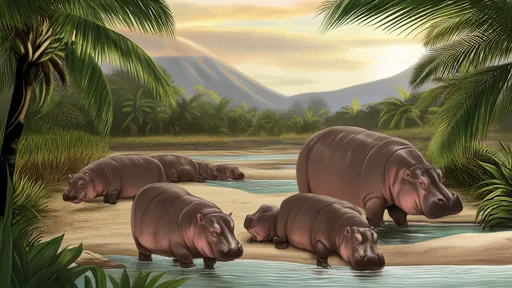
Perhaps even more astonishing than dwarf mammoths are the tiny hippos that once roamed Mediterranean islands like Cyprus and Crete. Fossil evidence reveals that these hippos were barely the size of a large pig—a far cry from their massive African relatives. How did these water-loving giants end up on islands, and why did they shrink so dramatically?
Scientists believe that during periods of lower sea levels, hippos may have swum or walked across temporary land bridges to reach these islands. Once stranded, with no natural predators and limited food, smaller individuals had a survival advantage. Over thousands of years, this led to a population of hippos that were a fraction of their original size. These dwarf hippos thrived for millennia, only to vanish when humans arrived, either through hunting or habitat disruption.
Evolution’s Laboratory: What Dwarfing Teaches Us
Island dwarfing isn’t just a historical curiosity—it’s a living laboratory for understanding evolutionary biology. By studying these cases, scientists gain insights into how species adapt to changing environments, how quickly evolutionary changes can occur, and what factors drive the shrinking (or growing) of species. The phenomenon also raises important questions about conservation: as habitats become fragmented due to human activity, could we see modern species undergoing similar dwarfing processes?
Moreover, island dwarfing challenges our perception of "fixed" species. It shows that size is not an immutable trait but a flexible one, shaped by necessity and opportunity. The next time you see a tiny island deer or a fossil of a dwarf elephant, remember—you’re looking at evolution in action, a testament to nature’s endless creativity in the face of constraint.
By /Jul 3, 2025
By /Jul 3, 2025
By /Jul 3, 2025

By /Jul 3, 2025

By /Jul 3, 2025

By /Jul 3, 2025

By /Jul 3, 2025
By /Jul 3, 2025
By /Jul 3, 2025

By /Jul 3, 2025
By /Jul 3, 2025
By /Jul 3, 2025
By /Jul 3, 2025
By /Jul 3, 2025
By /Jul 3, 2025
By /Jul 3, 2025
By /Jul 3, 2025
By /Jul 3, 2025