The world of two-dimensional materials has witnessed a groundbreaking development with the recent advancements in borophene applications. Dubbed as the "stronger cousin of graphene," this atomically thin material is demonstrating exceptional electrical conductivity and mechanical properties that could redefine multiple industries. Researchers now believe borophene may overcome several limitations that have hindered graphene's widespread commercial adoption.
A New Era in 2D Materials
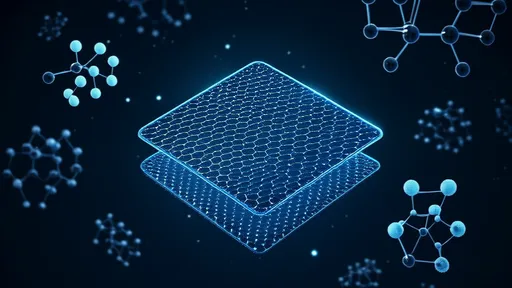
Since the isolation of graphene in 2004, scientists have searched for other 2D materials with superior or complementary properties. Borophene, composed of a single layer of boron atoms arranged in crystalline form, has emerged as a particularly promising candidate. What makes borophene extraordinary is its anisotropic conductivity - electrons flow more easily in certain directions - and its natural metallic properties, unlike graphene which requires doping to achieve similar conductivity.
Recent breakthroughs in synthesis techniques have enabled the production of high-quality borophene sheets with minimal defects. Teams at Northwestern University and the Argonne National Laboratory have developed a novel vapor-deposition method that allows precise control over borophene's atomic structure. This control is crucial because borophene can exist in multiple configurations (polymorphs), each with distinct electronic characteristics.
Surpassing Graphene's Limitations
While graphene boasts remarkable strength and conductivity, borophene appears to outperform it in several key aspects. Experimental measurements show borophene's electrical conductivity exceeds graphene's by approximately 60% at room temperature. More impressively, borophene maintains this superior conductivity while being significantly more flexible - a combination that could revolutionize flexible electronics.
The material's unique electron-phonon interactions prevent the conductivity degradation that plagues graphene at high frequencies. This property makes borophene particularly attractive for high-speed electronic applications where graphene's performance falters. Additionally, borophene demonstrates exceptional thermal conductivity, though measurements vary depending on the specific atomic arrangement.
Potential Applications Coming Into Focus
Several industries stand to benefit from borophene's unique properties. In electronics, borophene could enable ultra-fast transistors that operate at terahertz frequencies, potentially making it the material of choice for 6G communications and beyond. Its flexibility and transparency also make it ideal for next-generation foldable displays and wearable electronics.
The energy sector may see some of the most immediate applications. Borophene's high surface area and catalytic properties show promise for hydrogen storage and lithium-sulfur batteries, potentially doubling the energy density of current lithium-ion technology. Early experiments suggest borophene anodes could charge batteries up to five times faster than conventional materials while maintaining excellent cycle stability.
Challenges and Future Directions
Despite these exciting developments, significant challenges remain before borophene reaches commercial viability. Large-scale production remains difficult and expensive compared to graphene. The material's reactivity with air and moisture also necessitates protective coatings or encapsulation, adding complexity to device integration.
Researchers are actively working to address these limitations. Recent studies have demonstrated successful stabilization of borophene through atomic layer deposition of protective oxides. Other teams are exploring hybrid borophene-graphene structures that combine the strengths of both materials while mitigating their individual weaknesses.
As synthesis techniques improve and fundamental research continues, borophene appears poised to transition from laboratory curiosity to technological workhorse within the next decade. Its unique combination of properties may finally provide the toolkit needed to overcome the limitations that have constrained two-dimensional materials in practical applications.
The Road Ahead
The scientific community remains cautiously optimistic about borophene's potential. While it shows tremendous promise, the history of materials science is littered with examples of promising materials that failed to deliver commercially. However, the rapid pace of recent advancements suggests borophene may follow a different trajectory.
Major electronics manufacturers have already begun investing in borophene research, anticipating its potential to enable new device architectures. Meanwhile, government research agencies worldwide are increasing funding for borophene studies, recognizing its strategic importance for future technologies.
As we stand on the brink of this materials revolution, one thing becomes clear: borophene isn't just another 2D material - it represents a significant leap forward in our ability to manipulate matter at the atomic scale for technological advantage. The coming years will reveal whether it can fulfill its promise to become the foundation for the next generation of electronic, energy, and material technologies.

By /Jul 9, 2025
By /Jul 9, 2025

By /Jul 9, 2025

By /Jul 9, 2025

By /Jul 9, 2025
By /Jul 9, 2025
By /Jul 9, 2025

By /Jul 9, 2025

By /Jul 9, 2025
By /Jul 9, 2025

By /Jul 9, 2025

By /Jul 9, 2025

By /Jul 9, 2025
By /Jul 9, 2025

By /Jul 9, 2025
By /Jul 9, 2025
By /Jul 9, 2025

By /Jul 9, 2025