In a groundbreaking development that could reshape materials science, artificial intelligence has independently discovered new physical laws without human supervision. Researchers at the Massachusetts Institute of Technology (MIT) have demonstrated how machine learning algorithms can uncover fundamental relationships in material behavior that had eluded scientists for decades. This achievement marks a significant leap forward in autonomous scientific discovery and opens unprecedented possibilities for accelerating research across multiple disciplines.
The AI system, trained solely on raw experimental data without any pre-programmed physics knowledge, identified a previously unknown relationship between electron interactions and material deformation at quantum scales. What makes this discovery remarkable isn't just the finding itself, but the completely unsupervised approach that led to it. Traditional machine learning applications in science typically rely on human experts to frame problems and guide the search for solutions. In this case, the algorithm developed its own framework for understanding the data, revealing patterns that human researchers might never have thought to look for.
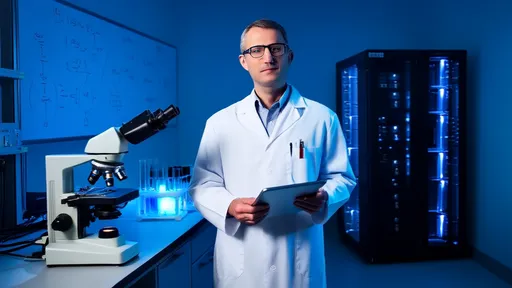
Professor Elena Rodriguez, who led the MIT research team, explains: "We fed the system nothing but terabytes of scattering patterns from X-ray diffraction experiments. There were no labels, no categories, no hints about what to look for. The AI treated it like a giant puzzle, testing countless configurations until it found mathematical relationships that consistently explained the observations." The emergent patterns turned out to correspond to physical laws governing electron behavior under strain - laws that had never been formally described in physics literature.
This breakthrough challenges conventional paradigms in both artificial intelligence and materials science. For decades, materials discovery followed a painstaking trial-and-error process, with researchers synthesizing compounds one at a time and testing their properties. Even with computational assistance, human intuition and existing theoretical frameworks heavily guided the search for new materials. The unsupervised approach demonstrates that AI can develop its own conceptual understanding of physical phenomena, potentially leading to discoveries that fall outside established scientific paradigms.
The implications extend far beyond the specific material laws discovered. Industries ranging from semiconductor manufacturing to renewable energy stand to benefit from accelerated materials discovery. Battery technology alone could see revolutionary advances if AI can reliably predict or discover new stable electrolytes or high-capacity electrode materials. Pharmaceutical companies are already exploring similar techniques for discovering crystalline forms of drugs with better bioavailability.
However, the research also raises profound questions about the nature of scientific discovery. When an AI system finds relationships that humans cannot intuitively understand, how should we validate them? The MIT team addressed this by designing experiments specifically to test the AI's predictions, confirming that the relationships held under controlled conditions. This validation process may become standard practice as unsupervised learning plays a greater role in scientific research.
Critically, the AI did not simply recognize patterns in existing data - it developed predictive capabilities that extended beyond its training set. When presented with entirely new material compositions, the system could accurately forecast their properties based on the underlying relationships it had discovered. This suggests the algorithm had uncovered genuine physical laws rather than merely memorizing data correlations. Such capability could dramatically reduce the time and cost associated with developing new materials for specific applications.
The technical achievement rests on several innovations in neural network architecture. The research team combined elements of convolutional networks for pattern recognition with symbolic regression techniques that can express discoveries as mathematical formulae. This hybrid approach allows the system to move beyond identifying correlations to formulating actual laws expressible in the language of physics. Unlike traditional deep learning models that operate as "black boxes," this architecture provides interpretable results that human scientists can analyze and verify.
As research continues, scientists anticipate these techniques will lead to discoveries in other areas of physics and chemistry. The same approach could potentially uncover new relationships in fluid dynamics, chemical reaction kinetics, or even cosmological phenomena. Each successful application reinforces the potential of unsupervised learning to expand the boundaries of human knowledge in ways we're only beginning to imagine.
The ethical dimensions of AI-driven discovery are coming into focus alongside the technological possibilities. Questions about intellectual property, proper attribution of discoveries, and the changing role of human researchers will require careful consideration. Some experts advocate for developing standards to ensure AI-discovered knowledge receives appropriate peer review and integration into the scientific canon. Others emphasize the need to maintain human oversight in applying such discoveries, particularly when they could lead to disruptive technologies.
Looking ahead, the research team plans to scale their approach to more complex material systems and collaborate with experimentalists to test additional predictions. Early indications suggest the method may be particularly valuable for understanding "messy" material behaviors where multiple physical effects interact in ways that defy simple theoretical models. By allowing the data to speak for itself, unsupervised learning could finally crack some of materials science's most stubborn puzzles.
This achievement stands as a testament to how artificial intelligence is evolving from a tool for analyzing data to a partner in the creative process of scientific discovery. As these techniques mature, we may be on the cusp of a new era where human and machine intelligence work in concert to explore the fundamental laws of nature - with each capable of finding what the other might miss.
By /Jul 9, 2025
By /Jul 9, 2025
By /Jul 9, 2025
By /Jul 9, 2025
By /Jul 9, 2025
By /Jul 9, 2025

By /Jul 9, 2025

By /Jul 9, 2025
By /Jul 9, 2025
By /Jul 9, 2025
By /Jul 9, 2025
By /Jul 9, 2025
By /Jul 9, 2025
By /Jul 9, 2025
By /Jul 9, 2025
By /Jul 9, 2025
By /Jul 9, 2025

By /Jul 9, 2025