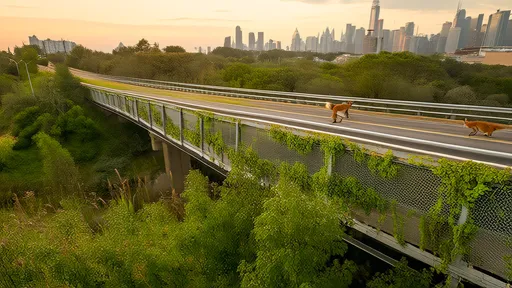
In the heart of our bustling cities, a quiet revolution is taking place—one that bridges the gap between urban development and wildlife conservation. Cities around the world are increasingly adopting an innovative solution to habitat fragmentation: ecological corridors, often referred to as "green bridges" or "wildlife overpasses." These structures, draped in lush vegetation, stretch across highways and urban sprawls, offering safe passage to animals and reconnecting fragmented ecosystems. It’s a testament to humanity’s growing awareness of its shared space with nature.
The concept of ecological corridors isn’t entirely new, but its application in urban settings marks a significant shift in how we perceive city planning. Traditionally, highways and dense infrastructure have acted as barriers, isolating animal populations and disrupting migration routes. The consequences are dire—genetic diversity dwindles, species face local extinction, and ecosystems lose their resilience. Green bridges, however, are changing this narrative. By mimicking natural landscapes, these aerial pathways allow deer, foxes, amphibians, and even insects to traverse human-dominated terrains safely.
One of the most striking examples of this innovation can be found in Banff National Park in Canada, where a network of overpasses and underpasses has reduced wildlife-vehicle collisions by more than 80%. The success of Banff’s corridors has inspired cities like Singapore, Berlin, and Los Angeles to invest in similar projects. In Singapore, the Eco-Link@BKE, a 62-meter-long vegetated bridge, reconnects two nature reserves separated by a busy expressway. Since its opening, researchers have documented a steady increase in the movement of species like pangolins and macaques, signaling a revival of ecological connectivity.
But building these bridges is no simple feat. Engineers and ecologists must collaborate closely to design structures that cater to the specific needs of local wildlife. The width of the bridge, the type of vegetation planted, and even the height of the surrounding fences—all play a crucial role in determining whether animals will use the crossing. For instance, some species prefer dense shrubbery for cover, while others require open spaces to feel secure. In the Netherlands, where wildlife overpasses are common, designers have gone as far as incorporating sand dunes and water features to attract amphibians and reptiles.
The benefits of urban ecological corridors extend beyond wildlife conservation. These green bridges also enhance the quality of life for city dwellers. By integrating natural elements into urban infrastructure, they serve as pockets of biodiversity, cooling the surrounding areas and improving air quality. In cities like Seoul, where the Skygarden project transformed an old overpass into a linear park, residents now enjoy a green oasis amid the concrete jungle. Such projects blur the line between urban and natural spaces, fostering a deeper connection between people and their environment.
Critics, however, argue that green bridges are merely a Band-Aid solution—a way to justify further urban expansion into natural habitats. They contend that while these structures mitigate some of the damage caused by infrastructure, they don’t address the root problem: unchecked development. Yet proponents counter that in an era of rapid urbanization, ecological corridors are a pragmatic compromise. "We can’t undo the roads we’ve built," says Dr. Helen Marsh, a conservation biologist, "but we can adapt our cities to be more inclusive of wildlife."
As climate change accelerates, the role of urban ecological corridors will likely become even more critical. Rising temperatures and shifting habitats force animals to move in search of suitable conditions. Green bridges could serve as vital lifelines, enabling species to migrate and adapt. Some cities are already future-proofing their designs. In Melbourne, Australia, planners are experimenting with "climate-proof" corridors—planting drought-resistant vegetation and creating microhabitats that can withstand extreme weather.
The movement to build urban ecological corridors reflects a broader shift in how we envision sustainable cities. No longer just concrete monoliths, cities are evolving into dynamic ecosystems where humans and wildlife coexist. Each green bridge is a small but powerful symbol of this transformation—a reminder that even in the most developed landscapes, nature can find a way. And as more cities embrace this vision, the hope is that these aerial pathways will weave a global network of resilience, one leafy span at a time.
By /Jul 9, 2025

By /Jul 9, 2025

By /Jul 9, 2025

By /Jul 9, 2025

By /Jul 9, 2025

By /Jul 9, 2025

By /Jul 9, 2025

By /Jul 9, 2025

By /Jul 9, 2025

By /Jul 9, 2025

By /Jul 9, 2025

By /Jul 9, 2025

By /Jul 9, 2025

By /Jul 9, 2025

By /Jul 9, 2025
By /Jul 9, 2025
By /Jul 9, 2025
By /Jul 9, 2025